
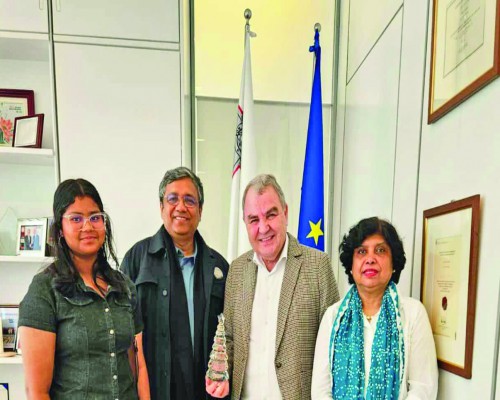
Honorary Consul of Republic of Malta in Bangladesh Shoeb Chowdhury paid a courtesy visit to the Speaker of Maltese Parliament Anglu Farrugia in Valletta in the afternoon of October 31, 2025. They exchanged views on the economic and social development of both countries and another few vital matters.
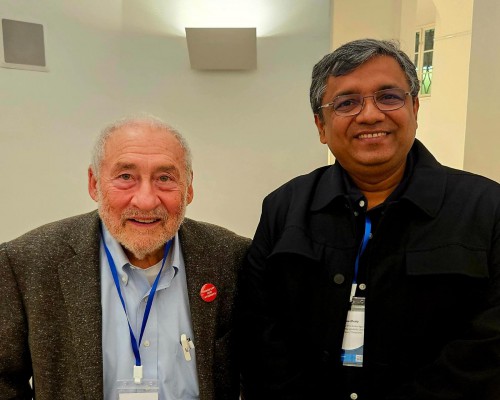
Nobel Laureate in Economics Joseph E Stiglitz has recently delivered a speech at an international assembly in the Austrian capital of Vienna.
The event, titled “Formulating a Work Strategy, Free Opinion and Unsolicited Interference in Journalism,” took place on October 23-25. It was organised by the International Press Institute.
Nobel Laureate in Economics Joseph E. Stiglitz has underscored the need for a clear work strategy, free opinion and freedom from unsolicited interference in journalism to uphold democratic values.
Addressing an international assembly in Vienna, Stiglitz highlighted the crucial role of public interest journalism in sustaining healthy, democratic societies amid the growing challenges of authoritarianism, disinformation, and artificial intelligence.
Speakers at the conference noted that suppression of dissent and obstruction of news publication are incompatible with the principles of a civilised society.
The three-day event, held in the Austrian capital from October 23 to 25, was organised by the International Press Institute, according to a media release.
Representatives from media organisations across 100 countries took part in the discussions.

Media outlets all over the world are currently devising different strategies to sustain their fame and acceptability in the middle of the augmentation of Artificial Intelligence or AI tools. Countries which will be able to keep pace with this innovative sprint faster can only stay on in the race while countries which cannot generate efficient and sustainable technicalities on time have to drop out of the competitive circumference that surrounds us.
In countries like Bangladesh, we can see that media houses often run into different hurdles. Media entrepreneurship in countries like ours often get disrupted and the entire news industry faces insurmountable challenges to work independently. As a result of frequent impediments posed by state organs, financial doldrums, political intervention, hostile tagging, antagonism from different quarters, newspapers are thrust into a blind alley where everything seems to have reached a point of no return. This is a perilous scenario for news industry and it heavily interrupts freedom of expression. Good governance, rule of law and socioeconomic justice cannot be established without freedom of press and people's liberty to speak out their opinions without fears.